Ib BIOLOGY

Friday, October 28, 2005

Tests marked

Hey guys

lol, I figure it's doubtful that anyone will check this until i get back, but here goes nuthin

I've marked your tests, and they are with Mr.L
I thought I was generous with the marks, and the average was pretty high... i think most ppl got killed on the M.C...which I thought was ok, but you can discuss that with him, or if you have any qustions you can ask me


As for your labs, Im sorry that I didn't mark them
I started to read them, and they were so well done!! I even read one that I thought was university caliber. There isn't enough hours in the day.

Hope you all have an amazing halloween
Be good, and I'll see you all when I get back

Thursday, October 27, 2005

Test questions

Here are the answers to the questions you've had so far:
1. No, I cannot give you a word bank. IB doesn't allow that, I already asked and tried to get that for you.

2. Saying that I lied is a bit harsh. I thought I was giving you a quiz, I apologize if it was a bit of a shock, however you were originally supposed to have the 'quiz' on everything, including reproduction. Actually, I was supposed to finish the reproduction unit with you guys, but we barely made it through half the material...

3. What diagrams? Didn't we already talk about that in class? There is one diagram, it's worth 6 marks... you have to label and know some of the ... actions of parts of the diagram

man, it's hard to give you hints without telling you what's on it...

4. I said this a few times in class....there are only MC questions for the respiration.

5. Dialysis... Please know what this is. I think that Oxford only covers the Hemotonial dialysis, but it would be good to know the 2 types, how they basically work, and be able to expand to filll, oohh, say, 10 marks? ;)

6. Podocytes are the 3rd layer that the blood encounters when being filtered from afferent vessel to make it to the proximal convoluted tubule.
The blood is forced through the afferent vessel, into the glomerulus, where it encounters 2 layers/membranes.

The first has little windows (it's fenestrated). The second is the basement membrane of the glomerulus. This is not permiable to large objects, such as blood cells and large proteins.

the third layer it encounters is the podocytes of the bowman's capsule. This is another layer that is not permiable to large blood cells (even though it has spaces, those spaces aren't large enough for cell passage).

I don't think I asked you specifically what a podocyte is, but it's good to know incase you have to know for the exam

7. the test is written by me, and also given to Ms.Leone's class....actually, it's not technically written by me, I got most of the questions from the IB exam booklet...I wrote a few questions, because I wanted what I tested you on to be fair, so I didn't put things in that I didn't specifically cover in my lectures. However, you will need to know the depth of OXFORD for your exam, so you'll have to review hormones and things for your test....

uh, did I say test? I meant exam.....
*hint hint, wink wink, say no more*


8. Im totally honoured that at least some of you like my classes. Im trying my best to make it interesting for both of us. To be honest, I haven't really done anything on humans, so this is pretty much new for me (it's been a good 4 or 5 years since I've done this stuff.....).

I really really really love teaching you all. I can't tell you how much I rant and rave to my friends and family about how much I love this class and MPSJ and working with Mr.Laudari. I look forward to seeing each of you every day, and I do truly see you all as a blessing and a gift straight from God.


I won't be gone for long, you'll see me in a month.
I'll be checking this when Im away, so if you have any questions, you can still reach me :)


Ok, back to the test stuff
MC: 20 marks
know some gas exchange stuff, homeostasis, and the kidney

Definitions: 8 marks
I took into account what you said today, and changed it a bit. you have a choice of 4 out of 5 defintions...
Fill in the blanks: 14

Short answer: 7 marks

Diagram: 6 marks... label and know how this thing works

Long answer: 10 marks
you get a choice out of 2 sets of questions.

Bonus:
I forgot to assign how many marks I'll give for bonus...Im thinking 2, but I'll talk to Mr. L about that. just remember a couple of the "interest pieces" we did in class


Stuff to review
- KIDNEY!! KNOW THE NEPHRON, how is it affected by ADH?
- Pancreas... know Hormones, where they are from and how they work
- in fact, tell me about hormones, what types and how they work
- thermoregulation
- excretion
- homeostasis things

There aren't too many things I could possibly test you on
AND one more thing

YOU'RE IBs!!!! I can't spoon feed you anymore, you know this stuff... think about what we do every day in class, I make sure I quiz you on the things I want you to know. We go over it every day. What did I stress each day?


Stop worrying so much about this, you guys will ace it
:)

Test question

is the test going to be as hard as the last one..like are there gonna be short answer questions and diagrams and multiple choice? or is it just like name the part and explain its purpose? how much is the test out of?


It's going to be pretty similar to the last test. There are M.C., short answer, some fill in the blanks and some longer answer questions

Im still debating whether or not Im going to ask you to draw for me, but Mr.Laudari said that you're going to have to be able to do that for your exam, so practice will be good.

Wednesday, October 26, 2005

TEST TIME!

Well, I promised that I would put a note here about the test on Friday.
Im presently sitting on my couch, writing the test.... well, more like pulling questions from the IB test booklet


KNOW OXFORD!!!
You should review everything we went over
- Nervous vs. Endocrine system
- Homeostasis
Thermoregulation
Pancrease and Liver (hormones)
Excretion (Nephron, kidney, dialysis, stones)

also, please come prepared for the lab tomorrow.
Mr. Laudari won't be there, and I need a higher level of cooperation with you as I won't have his help.

I really appreciate how well you all work :)

Keep on rockin :D

OH! and if we can finish early, Id like to show you all a small clip about reproduction and Invitro Fertilization... I should have picked that topic instead of spermatogenesis to do with you all....

Tuesday, October 25, 2005

Lesson Seven:Spam and Eggs.... Uh, I mean Sperm and Eggs

Eggs and Sperm…
…Where do they come from?
Oxford and SB2
Oxford: pp 90-93
SB2:pp 234 and 228, and read pp236-244 for clarification


Where does sperm come from?

SPERMATOGENESIS!!!
Seminiferous tubules in testis (over 100m per testis)
There are 2 layers: outer germ cell layer surrounded by a basement membrane

When the cells are in the Germ layer, they are called Spermatogonia. They are called Spermatocytes after the first round of Meiosis. AFter the second round of meiosis, they become spermatids. These cells become associated with nurse cells (seritoli cells), where they are fed and taken care of. They grow and differentiate, and become what we know as sperm.

Romeo-stasis
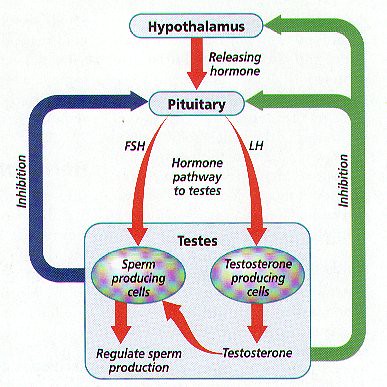
FSH! Where does it come from and what does it do?
It's released from the pituituary, and initiates the production of seminiferous tubules.
LH.What’s another name for this?
Interstitial Cell Stimulation Hormone
Stimulates intersticial cells (Leydig cells) to produce testosterone
Testosterone. What does it do?
It causes secondary sex characteristics to develope, increase in libido


Eggcellent
Oogenesis

Where do eggs come from?


Animation

Sunday, October 23, 2005

Lesson six: Reproduction (structures

Reproduction
*bow chicka wowow*
Hey, fish gotta spawn too!


Why learn about the Reproductive cycle?
Understanding Hormones
What is going on with my body?
You might be a parent some day
And have to understand things like tearing
Learn about interesting anomalies…


What is going on here?
Hermaphrodites.... They have both Male and female gonads.

Protec yo Neck
Turner's syndrome. These females have only one X chromosome (XO). Characteristics: Short stature, webed neck, stubby hands, loss of ovarian function, heart disease, increased kidney failure.

The Ys of Males
Individuals with Klinefelter Syndrome have the genetic make up XXY. Characteristics: underdevelopment of the testicles, a condition called hypogonadism, which usually leads to infertility, a taller-than-average height and a feminine body build, slightly lower IQ.

If these are wrong…
…then what’s right?
What are some characteristics of male development?
Male: facial hair, chest hair, larger voice box, more muscle
Female: enlarged breasts, rounder hips (birthin hips)

the Male System
Animation

Female
Animation

Romeo-stasis ;)
FSH and LH are found in the male system as well!
FSH promotes spermatogenesis
LH is called ICSH (interstitial cell stimulating hormone), --> stimulates testosterone secretion
Leydig cells found between the seminiferous tubules produce testosterone, which promotes secondary sexual characteristics, growth and activity of the male reproductive organs.

Don’t forget Juliet
Pituitary releases FSH, which causes a ripening of the follicle.
Follicle releases estrogen. Estrogen increases Endometrium thickness, and inhibits FSH., but stimulates LH production
LH stimulates ovulation and development of corpus leutium.
The Corupus lutium produces progesterone which keeps endometrium intact and inhibits FSH and LH
No fertilization? The Corpus Lutium degenerates and FSH is produced.


Look over pp104-106 Kindey stuff
SB2 pp228-230, 234-235