Ib BIOLOGY

Saturday, October 22, 2005

Lesson Five: Kidney Stones

KIDNEY STONES
Stones
If levels of calcium in the diet are too high, they must be removed, and this may lead to a build up and crystallization in the kidneys
Types of stones
Kidney stone

Animation

How to rid ourselves of stones?
LASERS

Friday, October 21, 2005

Questions...Oct 21

Hey guys
Please answer these questions in the comment box :)
you can keep them anonymous if you like, or if you feel comfortable, you can put your name


It's basically to get feed back on your learning styles and how I can better my teaching for you guys.

STOP
GO
CONTINUE

Under "STOP", please tell me things that I do that you would like me to stop, things that I do that annoy you, things that you find that hinders your learning.
(ie/do I talk to fast? do you like power point? Would you prefer more board diagrams? Notes on the board? Do I use too many animations? Not enought quizzing in class?)

Under the "GO" section, please tell me things that I don't do that you'd like me to start doing. For example, do you like handouts?

Under "Continue", things that I do right now that you'd like me to continue doing. (ie/ do you like when I show the pictures? What about the fish analogy? was that too cheesey?)

BE BRUTALLY HONEST
this is to benefit you guys

I dont' care if there are differing views out there, because you are all going to like different teaching styles. But I will try my best to adapt to how you learn best, because ultimately Im here for you :)

Thursday, October 20, 2005

Lesson Four: More Kidney...dialysis etc

REVIEW!!!
What do you know?
What is Glucagon?
Where are the hepatocytes found?
I found a white blob on my windshield this morning…what nitrogenous waste was it? (ps, Guano IS bird droppings :P )
Name some hormones we talked about
Tell me about the Kidney
What is it used for?
How many do we have?
Where is the nephron located? (the 2 areas)


Know your Role
What does the kidney do?

*POOF* no kidneys
What would happen?
Build up of Ammonia
Increase in blood pH (what is our body’s pH?)
Denatured Enzymes!
The waste concentration increases, causing a decrease in metabolic reactions.
No Osmoregulation (control of water balance)
Heart problems…blood volume not regulated.


Family Photos
Urine path
Kidney
Glomorulus
Nephron


Take a second look.
Review the parts of the kidney
Parts of the Kidney (are you up for the challenge?)

Are you in need of more Nephron knowledge?
Look at the ADH activity too!

Any questions?


What’s the difference?
Renal artery vs. Renal Vein
Renal artery has is oxygen rich, contains more urea, salt, and possibly more water
Renal Vein: has carbon dioxide, correct amounts of water, salts and very little urea.
Glomerular filtrate vs. blood plasma
Filtrate vs. blood: filtrate doesn’t have blood cells or large proteins.
Glomerular filtrate vs. Urine
Urine Contains less water, salt, no glucose, no proteins or AA’s, but lots of urea than


Back to my first question
What would happen if your kidneys disappeared?
What could you do?
DIALYSIS

Hemodialysis
Here, a person is hooked up to a machine (one of their veins)
Must go in a few times a week, and each session takes about 4 hours!
Works through diffussion across a semipermiable membrane....

The blood is drained, and flows through tubes emmersed in liquid. The liquid has the same solute concentration as blood, except has no urea, so the urea diffuses out.


Peritoneal Dialysis

A 12 inch Tube is inserted into the abdomen, and liquid is pumped inside. The blood filters naturally across the abdomen layer, the urea diffusing into the liquid. the liquid is replaced every so often.
There is a risk of infection, but at least you don’t have to be at the hospital

What about getting new ones?
Can anyone think of problems?
compatibility? If your body reconginzes the new organ as being foriegn, it will destroy it. ..what's being done? Scientists are trying to infuse Pig organs with human DNA so that the organs won't be rejected.

Lesson Three: The Kidney

Hey guys, sorry about posting late... as you can see by the time, it's midnight, and this is pretty much the first time my internet has been working since last monday.... yay for technology

here's what we did on Tuesday
:)

Enjoy!


* * * * *

They Kidney – Is your tank getting messy?

Nitrogenous waste
Who excretes what?

What would happen if your kidneys disappeared?
 Build up of Ammonia
 Increase in blood pH (what is our body’s pH?)
 Denatured Enzymes!
 The waste concentration increases, causing a decrease in metabolic reactions.
 No Osmoregulation (control of water balance)


Positions, please!

Keepin’ it Simple
Pathway of Urine
KIDNEY
What’s that?


Animations: Structure of the Human Excretory system
I couldn’t give you the link, so if you want to see it, come and talk to me. It was a good animation ☺


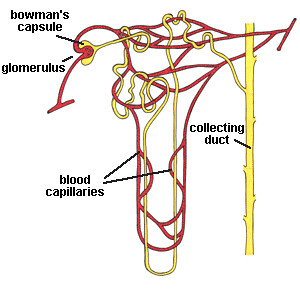
Nephron : Fluid/plasma part of the blood is pushed out of the vessel and into the nephron
Three principles
 Ultra-filtration
 There is high high pressure in the Glumerulus
 Reabsorption
 Secretion

Nephron
Parts of the Nephron
The blood vessel going from the renal artery to the glumerulus is called the different vessel. The efferent vessel carries blood from the glumerulus to the rest of the nephron, and them becomes the renal vein.


A sea of Glumeruli

Up close and Personal
The blood in the Glumerulus is under high high pressure. The blood is forced through the wall of the glumerulus and makes its way to the bowman’s capsule.

Glo meets Man
Blood that is forced from the glumerulus, enters the bowman’s capsule. Here big particles, like blood cells and large proteins will not get past the wall of the bowman’s capsule but the plasma and dissolved ions do.

All the blood in the body pass through the kidneys every 5 minutes, and 15-20% of the fluid that makes up the blood will make it into the bowman’s capsule, which is about 200 Litres!!

3 layers to contend with


Terms and Conditions
 Before we move on, we need to define some terms…
Osmosis… from Greek ōsmos ‘a push.’
 The movement of water across a semi-permiable membrane from an area of low concentration to an area of high concentration… water wants to be equal everywhere.
Active transport
 The movement of ions or molecules across a cell membrane into a region of higher concentration, assisted by enzymes and requiring energy.
Semi-permeable
 Seletive movement…a membrane that only allows certain substances through, and not others.
Impermeable
 not allowing things to pass through
Iso, hypo and hypertonic
Isotonic solution, the cell/vessel has the same ionic concentration as the surrounding solution. from Greek isotonos, from isos ‘equal’ + tonos ‘tone.’
Hypotonic solution: the solution has a lower ionic concentration than the cell/vessel (water will want to move from the low ion concentration to high ion concentration, therefore water will tend to flow into the cell).
Hypertonic Solution: The solution has a higher concentration than the cell/vessel in it (so, the water will tend to flow from the cell, into the surrounding fluid to balance it).

Boardtime

Detailed diagram of the Nephron…did board work.

Things to remember:
Areas that are semi-permeale
Parts that have active transport.
Concentration gradient

Can’t forget HORMONES!!
ADH
Anti-diuretic Hormone
Diruetic: Causes an increased passing of urine. From Greek diourētikos, from diourein ‘urinate,’

Soooo, ADH, when added to the blood stream, affects the membrane of the distal convoluted tubule(DCT). If diuretic means to urinate more (increase in water in the urine), than ANTI-diuretic Hormone will cause the body to decrease the water in the urine…so it causes an increase in permeability to water in the DCT, allowing the body to reabsorb more water.

Have too much water? The body doesn’t add any ADH, so it’s all flushed out in the urine. Not enough water? ADH is sent into the bloodstream, so you can reabsorb the water in the urine.

 Caffeine is a diuretic…what are the implications of this?
 A Diuretic, it causes you to excrete more water than normally, which can cause you to become dehydrated.

Websites
KIDNEY!!
Review the parts
Parts of the Kidney
(are you up for the challenge?)

Are you in need of more Nephron knowledge?


Where have we gone?
You should have finished: Sb2 pp247-259
Now please finish Sb2 pp265-268

“Ticket out of class” (a handout)

Monday, October 17, 2005

Lesson two: The Pancreas

HOMEOSTASIS!!
What’s in your fish tank?

REVIEW!!
Tank
Water
Food
Air pump
Heater
Thermometer
Water filter

THE NERVOUS SYSTEM
What makes up the CNS? ( the brain)
Peripheral NS? (everything else)

Negative Feedback

Review Animations
Homeostasis
Sweating

How Do Hormones work?

Hormones
Hormones are secreated by various organs in the body to effect change on target cells. There are two types of Hormones...steroid hormones and Amino Acid based ones

Steroid Hormones are able to penetrate the cell membrane and effect change right in the Nucleas. However, they need a receptor cell to affect.

Amino Acid based Hormones aren't able to penetrate the cell membrane...instead they effect change by attaching to a receptor protein on the outside of the target cell.

SB2 take a look at pg 252, 253

Fish has gotta eat!
You're not constantly feeding your face, so how does the body keep the level of glucose at an optimal level? HOMEOSTASIS! Your body has 2 hormones that are opposit, and counteract one another; they are used in various levels to maintaing a constant level of glucose in the blood.

The hormones are produced in the pancreas

After a huge meal, your body stores the excess glucose as a storable subastance called Glycogen. You are able to store this in your liver and muscles. If there is more glycogen than you body can store, then it is converted to adipose tissue (fat).

Check out that Pancreas


Where ‘s the Islet?
The Alpha cells produce a hormone called glucagon. This hormone targets the hepatocytes in the liver, causing them to turn the stored glycogen into useable glucose.

On the flip side, the Beta cells in the body produce insulin. This causes the hepatocytes to take glucose and transform it into glycogen. This hormone also causes the muscles to uptake more AA and turn it into protein.
What do they really look like?

Recap : the Endocrine System
ENDOCRINE


Food for Thought
Type I Diabetes - Juvenile onset diabetes
Type II Diabetes - adult onset diabetes


Fish needs a clean tank


Excretion
Who does what?
Plants and Photosynthesis - waste is Oxygen
Animals and Cell respiration - waste is carbon dixide

What are nitrogenous wastes?
Waste produced after AA’s are broken down (Deamination of AA’s results in NH3)
Ammonia is extremely toxic to living creatures, so it must be removed from the body.

How cheap are you?
Organisms want to expend as little energy as possible to excret their wastes, conserve as much water as possible.

Fish! They can excrete Ammonia because they are constantly expelling excess water. They dont have to transform the ammonia into anything.

Marine Animals excrete Urea and Trimethylamine oxide.../
Birds - Uric Acid (insoluble)
birds must ensure that they are carrying as little weight as possible, therefore their waste is almost a solid. It's insoluble uric acid, which doesn't dissolve in water. (the white stuff)
Mammals Urea... less toxic than ammonia,costs a lot to produce, but uses relatively little water.

What have you done for me lately?
Should have finished:
SB2 pp247-251, 255, 258

Please Finish
Oxford pp 52, 53
SB2 pp256-257, 260-264

Lesson One: Thermoregulation

In the same way, our body regulates the internal environment so that we function at our peak performance. Our body regulates:
- temperature
- pH (already learned about cabonic acid, H+ and bicarbonate ions)
- Oxygen and Carbon dioxide
- Blood glucose
- Water balance
HOMEOSTASIS
- homeo = same; stasis = standing

- There is the nervous system and the endocrine system

Nervous system is made up of the CNS (brain and spine) and the Peripheral nervous system (neurons…everywhere else) . This deals mostly with temperature.
Endocrine system is a system of glands that produce and secret hormones…but we’ll talk about that in a bit. The regulation of glucose levels is regulated by this system.


First, we’ll talk about temperature. There are two types of feed back systems, positive and negative. This isn’t to say that one is better than another, but each does something different.

Negative loop:
Temperature increases, body notices, decreases temperature by a number of ways, the temperature decreases below the set point, so the brain responds by increasing the temperature

Negative : The body does the opposit to keep the body in balance

Positive: The body augments the signal... ie/ Contractions at birth

Thermoregulation examples
too hot
- Vasodilation (skin arterioles)
- sweating
- decreasing metabolism (any reaction produces heat… ATP production, breaking down of glucose)
- behavioural adaptation (bathing(birds), throwing dust(elephants), urinating on legs (camel), dog panting)

too cold
- vasoconstriciton
- shivering
- increasing metablolism
- fluffing of hair or feathers (trap more air…like a down jacket)
- thick layer of brown fat or blubber
- special structure hair. (polar bear with hollow hair and absorb UV light)

- blood circulating around the body will distribute heat.


temperature falls below normal,b

first message

Hey Guys
Ok, here's the deal

I'll either post the slides from my lessons, or a summary with pictures and links.

You can leave comments and questions, but if they get inappropriate, Im shutting the website down...kapeesh?

Nonetheless, I hope you enjoy!

~Ms. Tenn-Yuk
ps, You can email your comments or questions to
ibbio.questions@blogspot.com