Lesson Three: The Kidney
Hey guys, sorry about posting late... as you can see by the time, it's midnight, and this is pretty much the first time my internet has been working since last monday.... yay for technology
here's what we did on Tuesday
:)
Enjoy!
* * * * *
They Kidney – Is your tank getting messy?
Nitrogenous waste
Who excretes what?
What would happen if your kidneys disappeared?
Build up of Ammonia
Increase in blood pH (what is our body’s pH?)
Denatured Enzymes!
The waste concentration increases, causing a decrease in metabolic reactions.
No Osmoregulation (control of water balance)
Positions, please!
Keepin’ it Simple
Pathway of Urine
KIDNEY
What’s that?
Animations: Structure of the Human Excretory system
I couldn’t give you the link, so if you want to see it, come and talk to me. It was a good animation ☺
Nephron : Fluid/plasma part of the blood is pushed out of the vessel and into the nephron
Three principles
Ultra-filtration
There is high high pressure in the Glumerulus
Reabsorption
Secretion
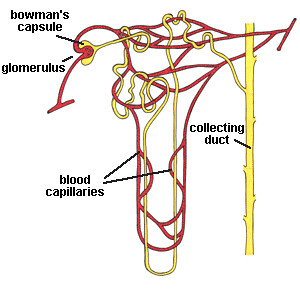
Nephron
Parts of the Nephron
The blood vessel going from the renal artery to the glumerulus is called the different vessel. The efferent vessel carries blood from the glumerulus to the rest of the nephron, and them becomes the renal vein.
A sea of Glumeruli
Up close and Personal
The blood in the Glumerulus is under high high pressure. The blood is forced through the wall of the glumerulus and makes its way to the bowman’s capsule.
Glo meets Man
Blood that is forced from the glumerulus, enters the bowman’s capsule. Here big particles, like blood cells and large proteins will not get past the wall of the bowman’s capsule but the plasma and dissolved ions do.
All the blood in the body pass through the kidneys every 5 minutes, and 15-20% of the fluid that makes up the blood will make it into the bowman’s capsule, which is about 200 Litres!!
3 layers to contend with
Terms and Conditions
Before we move on, we need to define some terms…
Osmosis… from Greek ōsmos ‘a push.’
The movement of water across a semi-permiable membrane from an area of low concentration to an area of high concentration… water wants to be equal everywhere.
Active transport
The movement of ions or molecules across a cell membrane into a region of higher concentration, assisted by enzymes and requiring energy.
Semi-permeable
Seletive movement…a membrane that only allows certain substances through, and not others.
Impermeable
not allowing things to pass through
Iso, hypo and hypertonic
Isotonic solution, the cell/vessel has the same ionic concentration as the surrounding solution. from Greek isotonos, from isos ‘equal’ + tonos ‘tone.’
Hypotonic solution: the solution has a lower ionic concentration than the cell/vessel (water will want to move from the low ion concentration to high ion concentration, therefore water will tend to flow into the cell).
Hypertonic Solution: The solution has a higher concentration than the cell/vessel in it (so, the water will tend to flow from the cell, into the surrounding fluid to balance it).
Boardtime
Detailed diagram of the Nephron…did board work.
Things to remember:
Areas that are semi-permeale
Parts that have active transport.
Concentration gradient
Can’t forget HORMONES!!
ADH
Anti-diuretic Hormone
Diruetic: Causes an increased passing of urine. From Greek diourētikos, from diourein ‘urinate,’
Soooo, ADH, when added to the blood stream, affects the membrane of the distal convoluted tubule(DCT). If diuretic means to urinate more (increase in water in the urine), than ANTI-diuretic Hormone will cause the body to decrease the water in the urine…so it causes an increase in permeability to water in the DCT, allowing the body to reabsorb more water.
Have too much water? The body doesn’t add any ADH, so it’s all flushed out in the urine. Not enough water? ADH is sent into the bloodstream, so you can reabsorb the water in the urine.
Caffeine is a diuretic…what are the implications of this?
A Diuretic, it causes you to excrete more water than normally, which can cause you to become dehydrated.
Websites
KIDNEY!!
Review the parts
Parts of the Kidney
(are you up for the challenge?)
Are you in need of more Nephron knowledge?
Where have we gone?
You should have finished: Sb2 pp247-259
Now please finish Sb2 pp265-268
“Ticket out of class” (a handout)
posted by Ms. Tenn-ilicious @ 12:04 a.m.




0 Comments:
Post a Comment
<< Home