Lesson Four: More Kidney...dialysis etc
REVIEW!!!
What do you know?
What is Glucagon?
Where are the hepatocytes found?
I found a white blob on my windshield this morning…what nitrogenous waste was it? (ps, Guano IS bird droppings :P )
Name some hormones we talked about
Tell me about the Kidney
What is it used for?
How many do we have?
Where is the nephron located? (the 2 areas)
Know your Role
What does the kidney do?
*POOF* no kidneys
What would happen?
Build up of Ammonia
Increase in blood pH (what is our body’s pH?)
Denatured Enzymes!
The waste concentration increases, causing a decrease in metabolic reactions.
No Osmoregulation (control of water balance)
Heart problems…blood volume not regulated.
Family Photos
Urine path
Kidney
Glomorulus
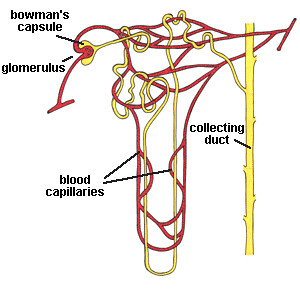
Nephron
Take a second look.
Review the parts of the kidney
Parts of the Kidney (are you up for the challenge?)
Are you in need of more Nephron knowledge?
Look at the ADH activity too!
Any questions?
What’s the difference?
Renal artery vs. Renal Vein
Renal artery has is oxygen rich, contains more urea, salt, and possibly more water
Renal Vein: has carbon dioxide, correct amounts of water, salts and very little urea.
Glomerular filtrate vs. blood plasma
Filtrate vs. blood: filtrate doesn’t have blood cells or large proteins.
Glomerular filtrate vs. Urine
Urine Contains less water, salt, no glucose, no proteins or AA’s, but lots of urea than
Back to my first question
What would happen if your kidneys disappeared?
What could you do?
DIALYSIS
Hemodialysis
Here, a person is hooked up to a machine (one of their veins)
Must go in a few times a week, and each session takes about 4 hours!
Works through diffussion across a semipermiable membrane....
The blood is drained, and flows through tubes emmersed in liquid. The liquid has the same solute concentration as blood, except has no urea, so the urea diffuses out.
Peritoneal Dialysis
A 12 inch Tube is inserted into the abdomen, and liquid is pumped inside. The blood filters naturally across the abdomen layer, the urea diffusing into the liquid. the liquid is replaced every so often.
There is a risk of infection, but at least you don’t have to be at the hospital
What about getting new ones?
Can anyone think of problems?
compatibility? If your body reconginzes the new organ as being foriegn, it will destroy it. ..what's being done? Scientists are trying to infuse Pig organs with human DNA so that the organs won't be rejected.
posted by Ms. Tenn-ilicious @ 1:04 a.m.




0 Comments:
Post a Comment
<< Home